RALUMO · RaiNews
Baia: technology and robotics at the service of underwater archaeological heritage
The Underwater Archaeological Park of Baia is at the heart of innovative European projects that combine archaeology, robotics, and marine geology. With initiatives like NERITES and ISPRA's LiDAR mapping, advanced tools are being developed to document, monitor, and make accessible an underwater heritage of exceptional value, threatened by bradyseism, transforming Campania into an international research laboratory.
Tools
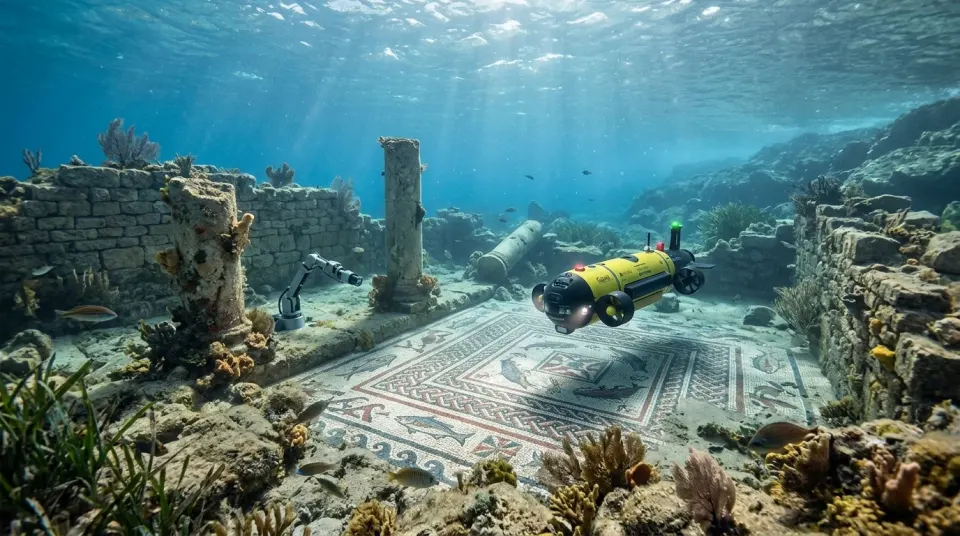
The Underwater Archaeological Park of Baia, in the Phlegraean Fields, is at the center of cutting-edge scientific research. As reported by RaiNews, the ancient Roman city, partially submerged by bradyseism, is becoming a laboratory where technology and history meet for exploration and conservation. Here, archaeology, robotics, and marine geology converge to protect a heritage of exceptional value.
Among recent initiatives, the European project NERITES, funded by Horizon Europe, conducted field tests in Baia between late August and early September 2026. The objective is to test an infrastructure with autonomous underwater vehicles, sensors, and three-dimensional reconstruction to monitor the sites. CNR-ISMAR of Naples contributes with specific expertise, strengthening research in Campania.
Another significant contribution comes from ISPRA. With the MER project, on June 5, 2025, it conducted a high-resolution aerial bathymetric LiDAR survey on the Campanian coast. This detailed mapping of the seabed of the Underwater Archaeological Park of Baia allowed for a clear distinction of ancient elements such as the marine walls and the Villa dei Pisoni.
The application of these technologies not only allows for precise documentation but also aims to make the heritage more accessible. Through digital photogrammetry, it is possible to create virtual reconstructions that allow exploring mosaics and imperial villas with their original colors. Baia thus establishes itself as an international model for the protection and sharing of a global heritage.
Sources and references
RaiNews · Updated: 28.10.2026 18:11 (Europe/Rome). Open official source ↗